
Maintenance service
Gate Maintenance Because heat and sand finish gates, not age
Almost every gate we are called out to repair in Oman failed for a reason that a service visit would have caught months earlier. A track packed with sand, a photocell drifting out of line, a roller flattening quietly under load. None of it announces itself until the motor stops.
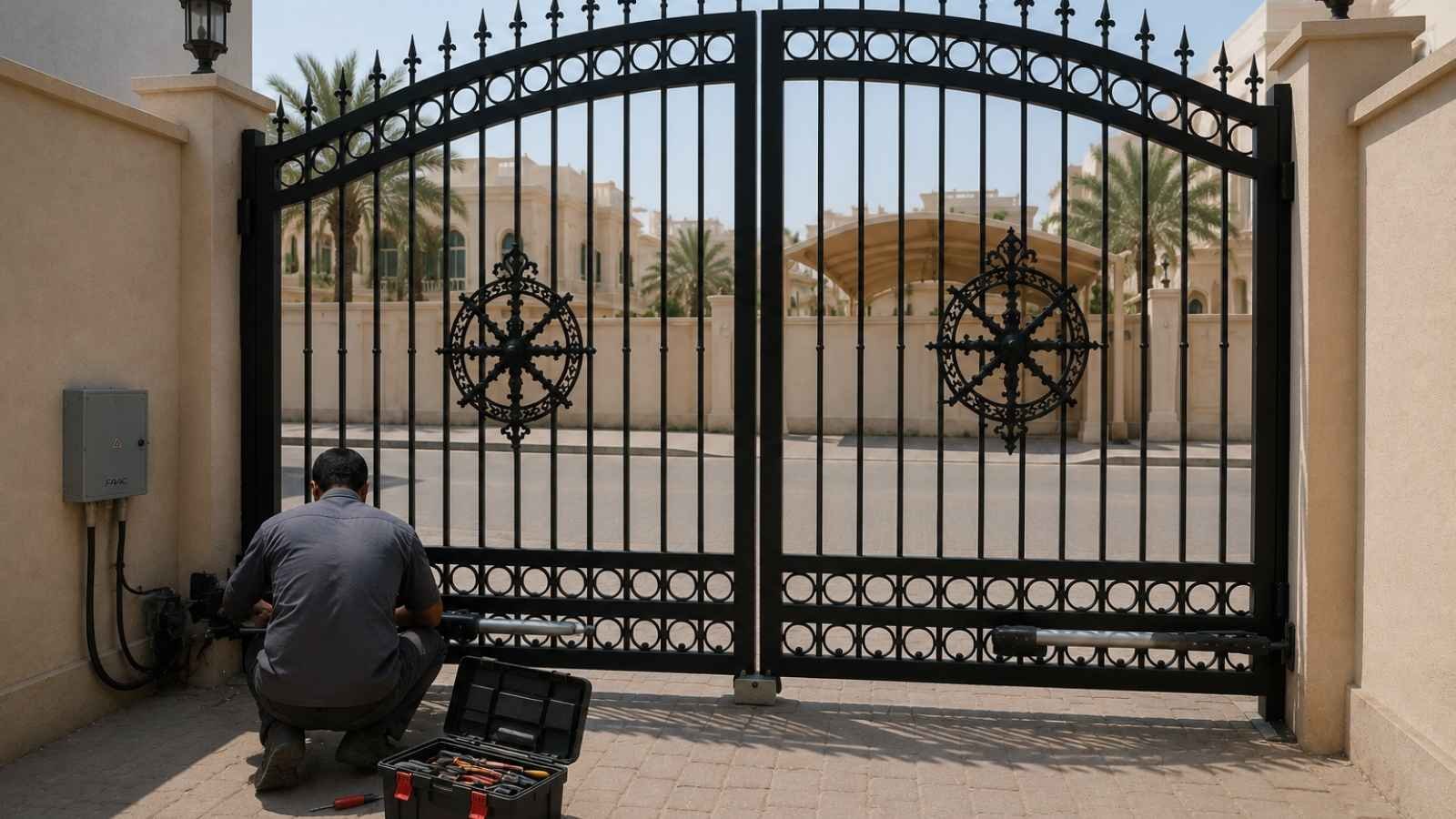
Why gates fail in Oman
Three forces, all of them local, none of them accounted for in the manufacturer's service interval. Those intervals are written for European conditions and they are not written for here.
-
Heat
The board is cooking
A control board sits in a sealed casing in direct sun. Above 45 degrees an operator already working hard reaches its thermal cutout and stops, which owners read as a fault. Do that every afternoon for three summers and the power section eventually gives up for good.
-
Sand
The track is filling
Blown sand settles into a sliding gate track and bakes in. Rolling resistance climbs, the motor pulls harder, and the extra current becomes extra heat. This is the single most common cause of failure we see, and it is entirely preventable with a brush and ten minutes.
-
Duty
The count is climbing
A motor wears out by cycle count, not by calendar. A villa gate opening six times a day and a compound gate opening two hundred times are two completely different machines by year three, whatever the label says.
What a service covers
A proper visit is mechanical and electrical, in that order, because most electrical faults on a gate start as a mechanical one.
Mechanical
- Track cleared of sand and debris along its full run
- Rollers and bearings checked for flat spots and play
- Rack alignment and pinion engagement checked
- Hinges, guides and end stops inspected and lubricated
- Gate moved by hand on manual release, to feel what the motor feels
- Fixings and foundation bolts checked for movement
Electrical and safety
- Supply voltage and earth tested at the board
- Control board inspected for heat damage and corrosion
- Photocells cleaned, realigned and tested by obstruction
- Obstruction force retested and reset if it has drifted
- Travel limits checked at both ends
- Beacon, remotes and any keypad or reader tested
- Manual release operated and the key confirmed present
How often
More often than the manual says, for the reasons above. These are what we recommend in Oman rather than what a European service schedule assumes.
- Villa gate
- Twice a year. Once before summer and once after it
- Compound or shared entrance
- Every three to four months
- Commercial barrier or high traffic gate
- Quarterly, and more often on a dusty site
- Coastal property
- Twice a year minimum. Salt air attacks anything exposed
Arranging it
We are putting together scheduled maintenance arrangements for villas, compounds and facilities, and the shape of those depends on how many gates you have and how hard they work.
For now, tell us what you have and where it is and we will agree a schedule and a figure with you directly. Nothing complicated, and nothing you have to sign before you know what it costs.
Tell us what you haveSigns yours needs one now
Any of these means the gate is already working harder than it should. None of them means it is broken yet, which is exactly why it is worth acting on them.
- It has become noisyGrinding, squealing or a rhythmic knock as it travels.
- It has become slowerOr it slows in the afternoon and recovers overnight, which is the thermal cutout.
- It hesitates or juddersRather than running smoothly from one end to the other.
- It stops part way and reversesThe obstruction limit is doing its job because the gate is now hard to move.
- You can see sand in the trackOr the rollers are running on a visibly dirty rail.
- It is heavy to push by handRelease it and try. It should move with one hand.
- You have not had it looked at in a yearIn this climate, that is already overdue.